

A SEED
Your sweetstill silence lurks
deep
inside the shadowed confines of a seed.
In noiseless patience it
waits
under the warmfilled days of your rain.
In that newtime of year your spring
comes
with its rare gift of April,
the smile of your sun.
You sigh and it happens:
Only the wind has known
you have parted your shell
and have grown.
NIGHT HARBOUR
Across the darkness of the horizon,
sparks of distant lightning burst soundlessly
in a reflection of the timeless moods of the skies.
Pale winking lights of ancient fishing vessels
rest silently within a sea of immutable space.
Distant stars commingle their radiance
with this earthly glow
as we stand here shoreless,
our uncircumscribed universe
extending to the unknown face
of the outermost planets.
With no marked beginning, now without end,
our eyes apprise:
between earth, the sea and the heavens,
no mark, no line of distinction.
Our worlds join and become one.
On this one night,
our lives are infinite.
John Bell Smithback
Cheung Chau
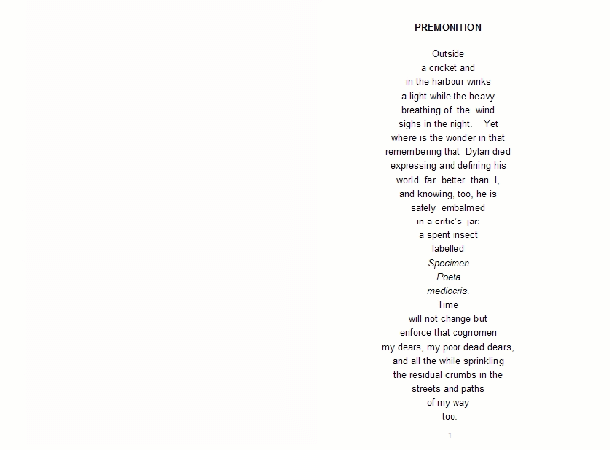
PREMONITION
Outside
a cricket and
in the harbour winks
a light while the heavy
breathing of the wind
sighs in the night. Yet
where is the wonder in that
remembering that Dylan died
expressing and defining his
world far better than I,
and knowing, too, he is
safely embalmed
in a critic’s jar:
a spent insect
labelled
Specimen
Poeta
mediocris.
Time
will not change but
enforce that cognomen
my dears, my poor dead dears,
and all the while sprinkling
the residual crumbs in the
streets and paths
of my way
too.
********************************************************************
*
- "With the war, and most immediately in response to the atomic bomb, a mood of unchannelled despair had come to prevail in the advanced sections of culture; the young in particular were seized with the sense of having destinies already arranged for them, of being governed by governments in which they were unable to make themselves heard, and of being implicated in decisions in which they had no voice. It was this sense of fatedness, of having lost all freedom of social will, of social choice that shaped their lives ..." Diana Trilling-------
*
- This is a book of extraordinary interest, giving evidence of one of the few serious writing talents in these parts since John Steinbeck. It has many of the elements of Greek tragedy, suffused with the overtones of the futile generations of the post-World War II era – shrill, showy, pathetic and impotent, the wrong arrivals on the wrong stage at the wrong time. This is a book that a man has sweat blood to write, and the odor gets through to the reader. Smithback's book is a provocative and disturbing one because of the images it conjures up, and it will not be easily or lightly forgotten… he is an involved, and therefore moving, artist … an expressive and important talent.
Robert Kaller
Monterey Peninsula Herald
*
- During the era of false and willful innocence which permeated Western civilization between World War I and World War II, it was quite the fashion for sensitive and intelligent young Americans to become expatriates, preferring the frantic ennui of Europe to the frantic competition of the United States.
It was this period of time and the attitude of these expatriates that Ernest Hemingway portrayed in THE SUN ALSO RISES. The scenes were basically the sidewalk cafes of Paris and one of the leading literary magazines – I believe it was "Dial" – said that the characters were as shallow in their emotions as the stacked saucers which denoted the number of drinks they had had.
The Europeans were startled our of their innocuousness in 1939, on which occasion most of the expatriates came running home to Mom and apple pie. The young Americans were finally and forcibly jarred out of their innocence at Pearl Harbor. The last lingering ingenuousness on either side of any ocean was blasted forever in the rubbish of the poisonous toadstool of Hiroshima.
In the 1950s and ‘60s, young Americans have not sought emotional refuge abroad, perhaps because a geographic haven from radioactive fallout is non-existent. They instead have renounced their country even while enjoying her sustenance: the earlier renunciation was physical, the latter is psychical. The commitment to rejection is no less complete for that. These young people are expatriates in their own country, and are the dramatis personae of John B Smithback's new novel, THE LONELY DARK.
We may not like these young people; we may find them shallow and cynical beyond belief. But if we will take the time to understand them – and we had better do so; they represent a segment of the more intelligent and sensitive young people of our day – we will find their facade more nearly a perverted idealism. (The real tragedy of the loss of John F. Kennedy, it seems to me, was that he knew how to appeal constructively to the best of this inherent idealism: witness the overwhelming response to the Peace Corps.)
The scenes of THE LONELY DARK are mainly the coffee houses and bars of New York. Jake Moore, the narrator, is older than the other characters, a member of the generation of World War II. Haunted by the memory of momentary panic in battle for which he damns himself, pursued by the Hounds of Heaven for the religion of his fathers', Judaism, Jake seeks again the lost innocence of us all and finds personal – though disturbed and possibly transitory – peace with a young girl, Karen.
But it is Gerald, the elegant and brilliant student who in bitter rejection of his own Judaism has embraced Hitler as God and elevated Nazism to a religion (the scenes of the rites are simply terrifying) who is the focal point of the story. The implicit death-wish in fascism is the leitmotif even during the pomp and ceremony of his rituals. For it is Gerald who breaks. It is Gerald who finally and literally carries out what Max Eastman, Hemingway's editor, described in a memorable phrase concerning an earlier generation: it is Gerald who commits "suicide as a protest against death."
This is not altogether an agreeable book; but for any who may wonder why those of us over 30 are not trusted by the young, it is well worth reading.
Reviewed by Robert Bradford
Editor, Kayros Review